
Mountains and Ethnic Groups of the Northwest and Dien Bien Phu


Overview
Itinerary Expand All
Day 1Arrival To Hanoi (L)
Upon your arrival at the airport, our guide and driver will welcome you and take you to downtown Hanoi.
Optional: Participate in a one-hour traditional Vietnamese massage session with medicinal herbs.
Afternoon: Visit the Ethnology Museum, which showcases the lifestyles, customs, and traditions of the 54 ethnic groups in Vietnam.
Visit the Buoi market, specializing in plants, ornamental trees, flowers, aromatic plant seeds, vegetables, and pets. Take a walk to visit the Long Bien Bridge for a beautiful view of the Banana Peninsula, and stroll along the tree-shaded Phan Dinh Phung Street.
Overnight at the hotel.
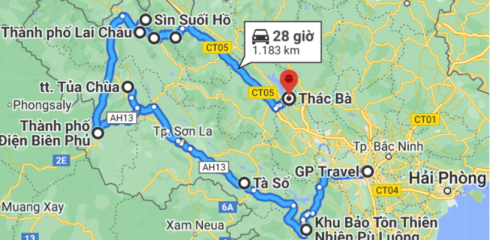
Day 2Hanoi - Pu Luong, Land Of The White Thai (B, L, D)
7:00 AM: Departure towards Pu Luong Reserve, taking a beautiful mountain road. You will arrive at Pu Luong around noon. Lunch at a local home. Afternoon: Take a walk along small trails lined with tropical vegetation and stilt houses with roofs covered in palm leaves. Discover the beautiful rice valley of Don, Ngon Leo.
Immerse yourself in the peaceful nature and enjoy stunning rural scenery: terraced rice fields, ponds, stilt houses of the Black Thai people nestled at the foot of the mountain. Observe the daily life of the villagers and their agricultural activities. Take this opportunity to interact with the local residents and capture beautiful photos. Overnight at a homestay.
Day 3Terraced Rice Fields Of Pu Luong - Ta So (B, L, D)
After breakfast, transfer to the suspension bridge over the Cham River, where you will see magnificent water wheels (noria) installed on the banks of the stream, one of the iconic images of Pu Luong. These gigantic water wheels are a clever irrigation system that brings water from the stream to the rice fields. Approach each wheel and discover this original irrigation method of the Thai ethnic group; you will understand how water passes from a river to a bamboo aqueduct handmade through very simple installations of all sizes.
Take a bamboo raft ride along the stream to fully enjoy the serenity of nature and the picturesque landscapes on both sides of the stream. You can try your hand at paddling and steering your bamboo raft. Depart for Moc Chau, a beautiful valley known for its dairy farms, plum orchards, apricot gardens, and tea hills. Lunch en route.
Afternoon: Visit the Moc Chau Plateau: tea plantations, orchards, or flower gardens. In the winter season around December, you can visit a plum blossom garden, and as the Vietnamese New Year approaches, a field of yellow mustard flowers. Upon arrival at Ta So, take a short walk in the valley, meet the Hmong people, and try batik. Night in a homestay in a private room.
Day 4Ta So – Tua Chua (B, L, D)
Breakfast at the homestay. Departure towards Tua Chua, a remote corner of Dien Bien. Stop along the way to visit villages of ethnic groups. Visit the former Son La penitentiary.
You will arrive in Tua Chua by the end of the day. Visit the Tua Chua night market. Overnight stay in a guest house.
Day 5Weekly Market Of Tua Chua - Dien Bien Phu (B, L, D)
Visit to the weekly market of Tua Chua, held every Saturday evening and Sunday morning. Then, embark on a journey to Dien Bien Phu (170 km), passing through a region inhabited by the Black and White Thai ethnic groups. Along the way, stop at the Thuan Chau market, where Black Thai women gather to exchange various agricultural products and handwoven brocades. Another stop will be made at the Pha Din Pass (1648m), one of the highest mountain passes in the North, offering breathtaking views of the valley villages.
Dien Bien Phu holds a strategic position near the borders of three countries: Vietnam, Laos, and China. It was the main battlefield between the Viet Minh and the French Expeditionary Corps in 1954.
Overnight stay at a hotel in Dien Bien.
Day 6Historical Sites Of The Battle Of Dien Bien Phu (B, L)
Enjoy delicious breakfast.
8:00 AM: You will visit Dien Bien Phu - the largest French military base in Asia during the Indochina War (1954). You will explore the remains of the decisive battle between the French and the Viet Minh in 1954: the Dien Bien Phu Museum, Hill A1/Eliane, General De Castries' command post, and finally, the Rodel Monument (the Memorial of the soldiers of the French Expeditionary Corps erected in 1992 by a legionnaire of the 3rd REI in memory of his fallen comrades during the battle). These are must-visit sites for those interested in the history of French colonization in Indochina.
Afternoon: You will head towards the Muong Phang valley to visit the former Command Post of General Vo Nguyen Giap. A short forest hike (1 km) to visit the legendary cave of General Giap. Then return to Dien Bien by crossing Lake Pa Khoang with stop to visit a village of the Thai Ethnic Group.
Overnight stay in Dien Bien Phu.
Day 7Dien Bien Phu - Lai Chau - Sin Suoi Ho (B, L, D)
Afternoon: Coach trip to Lai Chau through a wild region inhabited by various ethnic groups: Thai, Mong, Dzao, Kho Mu, Lao, Hani, Mang, etc. The road follows small, narrow valleys overlooked by forested hillsides.
Take a tea break in Muong Lay, a modern city that has resettled hundreds of Thai villages previously located in valleys flooded by the Lai Chau - Son La hydroelectric reservoir. Cross the Black River and continue your journey to Lai Chau. Throughout your drive, you'll be accompanied by the Nam Na River and stunning surrounding landscapes.
You'll encounter Thai and Red Hmong villages along the way before reaching Sin Suoi Ho, a remote village known for its Protestant Hmong community.
Take a walk through the exotic village where many orchids are cultivated.
Day 8Sin Suoi Ho - Tam Duong, Visit To A Lao Lu Village - Sapa (B, L, D)
Visit the weekly market in Sin Suoi Ho (Saturday mornings). Stop in Tam Duong to visit Na Tam - a peaceful and picturesque village of the Lao Lu ethnic group.
Lao Lu women traditionally have black lacquered teeth and wear original indigo costumes consisting of a richly ornamented front-opened jacket with silver pieces and an embroidered skirt. Their outfits are complemented by charming hairstyles.
Then, depart by car to cross the Hoang Lien Son Mountain Range via the magnificent O Quy Ho Pass. This pass is located at an altitude of 2047 meters and stretches 54 kilometers, making it the longest and highest pass in Vietnam. Take a break here to enjoy the breathtaking scenery. It's also an ideal spot for beautiful photos.
Upon arrival in Sapa, follow a trail that crosses the stream dividing the valley surrounded by terraced rice fields. On your descent, you'll encounter friendly Hmong women and children living in houses nestled in the valley. Take a leisurely stroll along the Muong Hoa River, from the Black Hmong village of Y Linh Ho to Lao Chai. Visit a Day family that manufactures incense cones.
Overnight in Sapa.
Day 9Sapa - Muong Bo Valley - Thac Ba Lake (B, L, D)
Transfer to Muong Bo Valley, visit a Red Dzao village, and enjoy the balcony-like landscapes of terraced rice fields.
Lunch with a local family.
Afternoon: Travel to Thac Ba Lake via the highway. Overnight stay with a Dzao family by the lake.
Day 10Thac Ba Lake - Hanoi (B, L)
Following your exploration of Thac Ba Lake, a motorized sampan cruise offers an immersive experience into the daily activities and local life. Witness traditional fishing techniques such as the use of dip nets and bamboo shrimp traps amidst the picturesque backdrop of cajeput-covered hills emerging from the water. Enjoy a homestay lunch, further enriching your cultural encounter.
In the afternoon, commence your return journey to Hanoi, a four-hour drive covering approximately 160 kilometers. This segment of your itinerary encapsulates the tranquility of Thac Ba Lake's surroundings while ensuring a seamless transition back to urban settings.
Day 11Hanoi – Bai Tu Long Bay, Overnight Cruise (B, L, D)
8:00 - 8:30 AM: Collective Dcar Limousine transfer to Sun Pier Boarding at noon. Transfer by small boat to reach the hotel boat.
12:45 PM: Welcome drink and brief presentation about safety instructions on board and itinerary.
1:30 PM: Lunch on board as the boat sails towards Bai Tu Long Bay.
3:00 PM: The boat sails to the Cong Do and Cap La region, kayak activity through the karst rocks. Possibility to stop at a wild beach depending on the tide.
5:30 PM: Return on board and relaxation on the upper deck.
7:00 PM: Dinner on board. Free evening for squid fishing. Night on board the Renea Cruise.
Day 12Bai Tu Long Bay - Hanoi (B, L)
Day 13Hanoi City Tour (B, L)
A day dedicated to exploring the city: The Temple of Literature, the first national university built in 1070 where royal sons and sons of mandarins pursued their studies to become scholars and high-ranking officials. This temple also honors Confucius and the Scholars of the Kingdom. With its original architecture arranged between courtyards, ponds, and gardens, it is a true haven of peace and greenery in the heart of the capital.
Ba Dinh District: Stroll through Ba Dinh Square, the botanical garden, the former Governor's Palace of Indochina (now the Presidential Palace), Ho Chi Minh's stilt house, and finally the One Pillar Pagoda, one of the oldest monuments in the city built in 1049.
The Pagoda of the Defense of the Country (Tran Quoc), built in 1615 on the edge of the large West Lake.
The Old Quarter of Hanoi, known as the commercial center of the capital bordered by the elegant Hoan Kiem Lake. Despite the passage of time, the Old Quarter is known as an open-air museum of the capital: unique tube houses, small alleys, temples, open-air markets. Passage to the train street. Lunch: You will taste grilled pork with vermicelli and egg coffee.
The evening is devoted to a traditional water puppet show, a typical folk art of Northern Vietnam combining traditional music and scenes of rural life.
Night at the hotel.
Day 14Hanoi - Departure (B)
You will have your leisure time at the hotel, then a car will pick you up to transfer to the airport for your departure flight. GP Travel sincerely hope you've enjoyed your trip, and we thank you for choosing us!
We wish you a safe flight and we look forward to traveling with you again soon.
Prices and Accommodation
How to book?
-
Enter your travel date, the number of adults, and the language
-
Click "Book this tour" for price, then "Book now" to reserve.
-
"Pricing is for up to 6 adults. For larger groups, please request a customized offer in your 'special requests'
Included
- Accommodation
- Transportation according to the program in a private vehicle with a driver for your EXCLUSIVE group
- Meals as mentioned in the program: B = breakfast, L = lunch, D = dinner
- English-speaking guide
- Visiting fees and entrance fees to the sites
- One liter of bottled water per day per person, Handling fees
Excluded
- Visa if need, personal travel insurance
- Bank fees, drinks, phone calls, personal expenses, and anything not clearly mentioned in the "This price includes" section
- Surcharge during public holidays (if any)
- Tips (based on your satisfaction, a suggested reference is $5 USD/day/traveler for guides and half that for drivers)
Useful Information
- Safety equipment: bring hiking shoes, a flashlight, and insect repellent for mosquitoes, sunscreen from April to November, warm clothing during the winter (mid-November to early March), a towel, and a toiletry kit.
- The best time to admire the terraced rice fields is from the end of June to August. The terraced rice fields in the high mountains of Sapa, cultivated in May and harvested before September.
Similar Tours

Vietnam Essentials - 14 Days
Hanoi - Bai Tu Long Bay - Ninh Binh - Quang Tri - Hue - Hoian - Hochiminh City - Ben Tre - Can Tho
Discovery & Culture
The landscapes of three major regions with very different beauty: karst peaks, rice paddies and arroyos of the Mekong Delta, coconut jungle, and magnificent traditional architectural monuments.
Two exceptional karst sites: Halong Bay and its "Terrestrial" version in the Ninh Binh region.
Two must-see historic coastal cities: the Imperial City of Hue and the ancient town of Hoi An.
Rich activities with highlights: Cruise in Halong Bay, bike rides through the countryside of Ninh Binh, sampan rides to visit the Cai Rang floating market and the arroyos of the Mekong Delta.
Vietnam Panorama - 10 Days
Hanoi - Ha Long Bay - Ninh Binh - Hue - Hoian - Hochiminh City - Can Tho
Discovery & Culture
- The discovery of three very different major regions: the karst landscapes of Ha Long Bay and its "inland" version, the historic coastal cities of the Central region, and finally, the Mekong Delta.
- Mountain landscapes, karst peaks, stunning beaches, and canals, each more beautiful than the last.
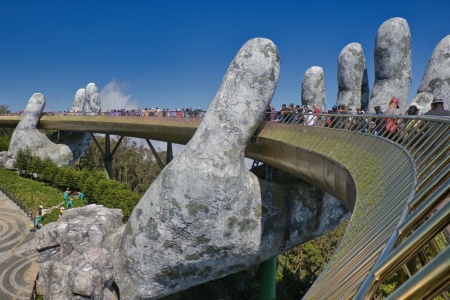
- The Famous Golden Bridge in Da Nang.
- The cable car ride with an experience of panoramic views of the wooded hills of Ba Na.

Upper Tonkin's Tribes : Ha Giang, Cao Bang & Bai Tu Long Bay
Hanoi - Ha Giang - Dong Van - Meo Vac - Cao Bang - Ban Gioc Waterfall - Ba Be - Bai Tu Long Bay - Ninh Binh
Authentic & Nature
- Two nights on a boat in Bai Tu Long Bay for relaxation
- The best of Vietnam's karst mountain landscapes: Dong Van Plateau Geopark & the Meo Vac and Cao Bang Massifs - the region of a thousand karst rocks in Trung Khanh
- Ban Gioc - The Ban Gioc Waterfalls, the most beautiful waterfalls in Vietnam, and the Nguom Ngao Cave
- Discovery of an exceptional ethnic market
- A tour away from mass tourism, favoring authentic encounters and experiences with the ethnic groups in the
- Great Northern Mountains, discovering their ancestral way of life: Hmong, Nung, Lolo… Ninh Binh, terrestrial Ha Long Bay and local life