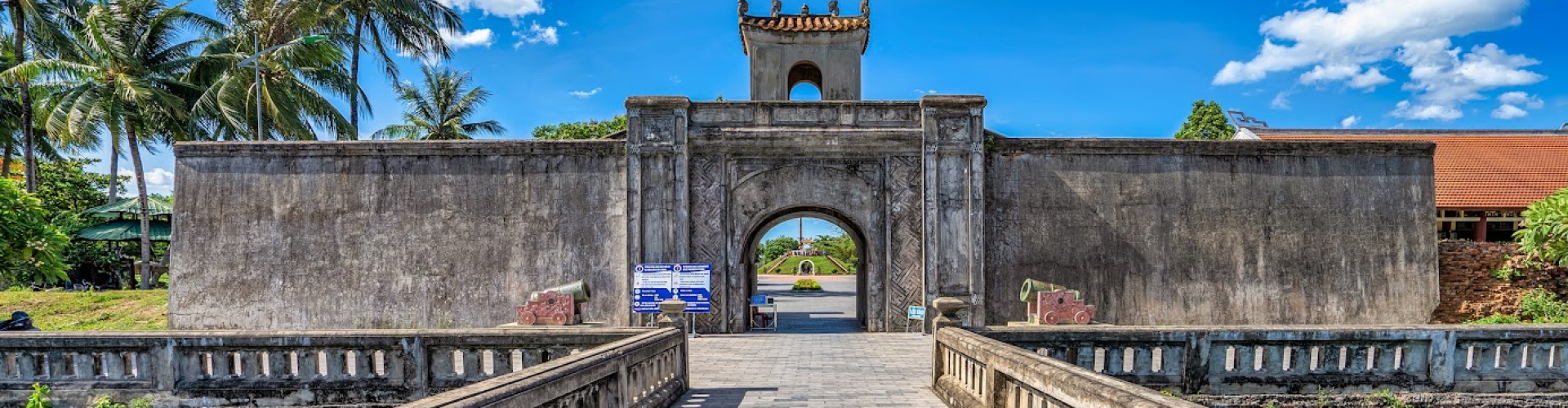
Quang Tri
Located in central Vietnam, Quang Tri Province is historically significant as the dividing line between North and South Vietnam following the 1954 Geneva Accords. The Ben Hai River served as the natural boundary, with the Demilitarized Zone (DMZ) forming a 5-kilometer-wide buffer zone stretching from the Laotian border to the coast along the 17th parallel north.
To the north of the DMZ lay the Democratic Republic of Vietnam, led by Ho Chi Minh and the Communist Party, while the State of Vietnam to the south was initially ruled by former Emperor Bao Dai, later falling under U.S. influence.
The Vietnam War lasted for 21 years, with Quang Tri witnessing intense bombings and fierce battles. Today, war remnants are preserved on both sides of the DMZ and are open to visitors, offering a poignant insight into Vietnam’s history.
Things to see and do
Hien Luong Bridge
This historic bridge spans the Ben Hai River, marking the former division between North and South Vietnam. During the war, the bridge—originally built by the French—was painted in two distinct colors, symbolizing the separation.
Key Features:
+ A massive flag tower on the northern side, with a socialist mosaic monument at its base.
+ The Reunification Memorial on the southern side.
+ Old propaganda loudspeakers, remnants of psychological warfare between the two sides.
+ A small museum near the bridge showcasing wartime images and artifacts.
+ A sculpture named "Desire for a Unified Country", depicting a mother and child waiting for their husband/father to return.
Vinh Moc Tunnels
Located on the northern side of the DMZ, near the East Sea, Vinh Moc was once a village subjected to relentless U.S. bombings. In response, locals dug an underground tunnel network to survive.
Vinh Moc is not a combat tunnel like Cu Chi, but a civilian shelter. It has three levels, the deepest at 30 meters underground. A 3-km-long network that housed 60 families for several years. Built to withstand "free-fire zone" bombings, as the U.S. suspected villagers of aiding North Vietnamese forces on nearby Con Co Island.
Today, visitors can explore the tunnels, gaining a firsthand experience of life underground during wartime.
Ho Chi Minh Trail & Truong Son War Cemetery
The Ho Chi Minh Trail—also called the Truong Son Trail—was a covert supply route built by North Vietnam and the Viet Cong. This vast network of mountain and jungle paths enabled the transport of troops, food, and weapons from North to South Vietnam.
Important Facts:
Construction lasted over 6,000 days, with 10,000 lives lost maintaining the route.
The Truong Son War Cemetery (built in 1973) is the largest war cemetery in Vietnam, honoring over 10,000 fallen soldiers.
Many graves are symbolic, representing the 300,000 missing soldiers still unaccounted for.
This site is a place of deep remembrance, offering insight into the sacrifices made for Vietnam’s reunification.
Khe Sanh Combat Base
Situated south of the DMZ, near the Laotian border, Khe Sanh was a key U.S. military outpost. It served as part of McNamara’s anti-infiltration barrier, equipped with modern weapons, chemical warfare, and motion sensors designed to block North Vietnamese troop movements. Why was it significant?
Located near the Ho Chi Minh Trail, the base aimed to disrupt North Vietnamese supply routes.
The battle of Khe Sanh (1968) became one of the bloodiest engagements of the war, often compared to the Dien Bien Phu battle (1954).
Today, visitors can explore:
Khe Sanh Victory Museum, displaying photos and artifacts from the battle.
Ta Con Airfield, featuring wrecked U.S. aircraft and war relics.
This site offers a powerful glimpse into the war’s intensity and the Vietnamese struggle for reunification.
Good to Know
When to visit?
You can visit all of the year
Access
+ By train and by bus
Continuing your journey
+ Hue
+ Phong Nha Ke Bang